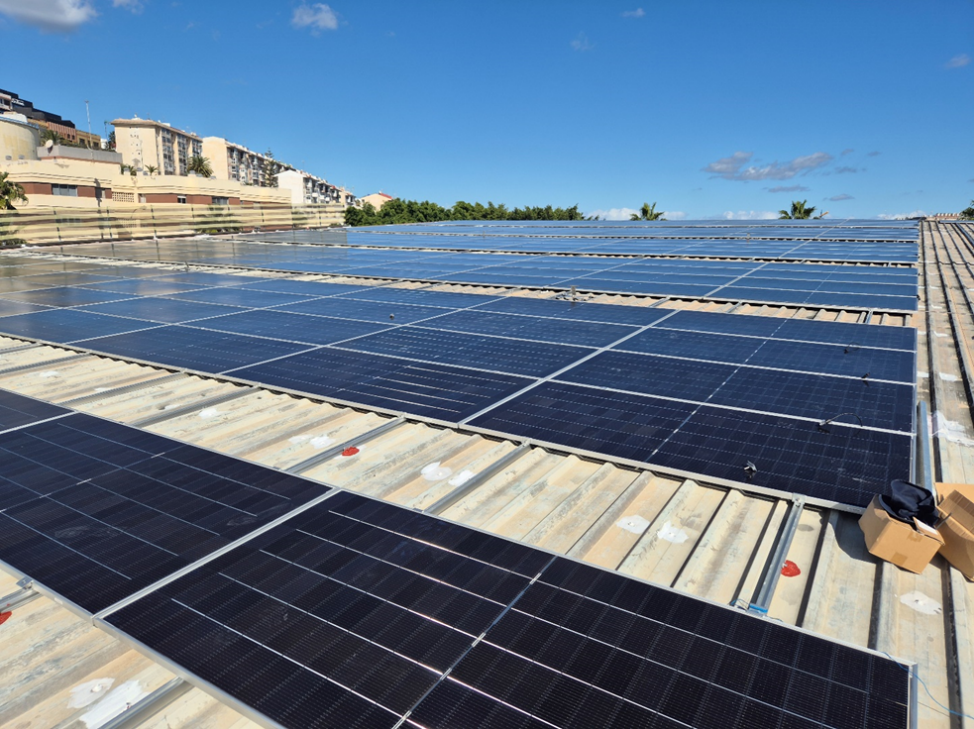
La actuación se ha ejecutado con 501 módulos monocristalinos bifaciales de 590 Wp instalados sobre cubierta metálica con estructura coplanar, con un sistema eléctrico distribuido en tres inversores. La inversión total asciende a 428.005 euros.
Why it matters: This project's inflated €1.58/Wp price point creates a false benchmark for C&I clients—be ready to explain why your private bids are half the price of high-profile government installs.
If you are a commercial solar installer in Madrid or Berlin looking at these numbers, you probably just spat out your coffee. For a 270 kWp rooftop installation, a total investment of €428,005 works out to roughly €1,585 per kilowatt-peak. In a market where utility-scale is sub-€0.60 and competitive C&I (Commercial & Industrial) rooftops are regularly hitting €0.70 to €0.90/Wp, this Gran Canaria project looks less like a clean energy win and more like a public procurement cautionary tale.
The Bifacial Fallacy
Let’s talk about the technical choices. The project uses 590 Wp bifacial modules. On paper, bifacial is great—until you put it on a coplanar metal roof. By mounting these panels flush to the roof surface, you are effectively killing the albedo effect. Without a significant gap (at least 30-50cm) and a reflective roof surface, that rear-side gain is virtually zero. You are paying a premium for bifacial technology—likely from a tier-1 like LONGi or Trina—and then suffocating its potential. For installers, the lesson is clear: don't upsell bifacial for coplanar residential or C&I metal roofs unless you enjoy explaining to the client why the "extra yield" never showed up on the monitoring app.
The Logistics Excuse vs. Reality
Defenders will point to the "insular tax"—the cost of shipping components to the Canary Islands and the localized labor rates. While logistics to Las Palmas add friction, they don't justify a 100% markup over mainland Spanish pricing. This budget smells like a project weighed down by administrative overhead or gold-plated electrical infrastructure that 270 kW simply doesn't require. If you're bidding for municipal work in the EU under the Recovery and Resilience Facility (RRF), don't let these inflated public figures fool you. Private clients won't tolerate these margins.
A Benchmarking Reality Check
As professionals, we should celebrate every megawatt added to the grid, but we must also call out inefficient capital allocation. High-cost public projects inflate market expectations and make it harder for honest installers to sell ROI-driven systems to private business owners who see these headlines and think solar is twice as expensive as it actually is.