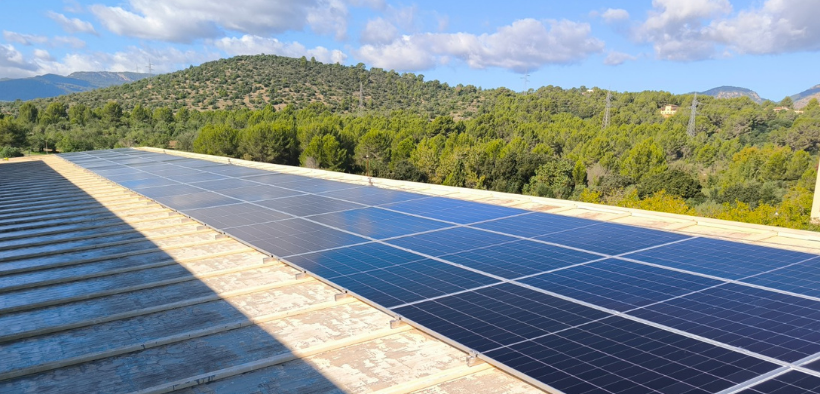
La Fundació Universitat‑Empresa de les Illes Balears ha ampliado la generación fotovoltaica en la UIB con 189,8 kWp en la cubierta de CampusEsport y 258,7 kWp en la fase 3 de las marquesinas de Can López.
Why it matters: Solar carports are moving from 'nice-to-have' to 'legally required' across many EU regions—mastering the structural and EV integration now is the only way to protect your C&I margins.
While a 448 kWp project at the University of the Balearic Islands (UIB) might look like standard institutional fare, the split between rooftop and carport—and the geographic context—reveals a massive shift in the Spanish C&I landscape. Look at the numbers: the carport component (258.7 kWp) is nearly 40% larger than the rooftop installation. This isn't an accident; it’s a direct response to Ley 10/2019 de cambio climático y transición energética, which effectively mandates solar coverage for large outdoor parking lots in the Balearics.
The Complexity Premium
Most residential installers flee from carports because they aren't just 'solar on a stick.' They involve civil engineering, foundation work, and wind-load calculations that make a standard flat-roof ballast system look like LEGOs. However, for a professional developer, this complexity is a moat. In the UIB project, the integration of five double EV charging points (10 plugs total) into the structure isn't just an add-on; it’s the logical conclusion of the 'solar canopy' model. If you are still bidding on C&I projects by only looking at the roof, you are leaving more than half the potential contract value on the table.
Why Carports Win the ROI Argument
In high-irradiance regions like Mallorca, the thermal stress on rooftop membranes is a long-term liability. Carports, conversely, provide shade that reduces the cooling load of the vehicles beneath them and utilizes otherwise 'dead' space. For the UIB, this is Phase 3 of their 'Can López' site. This tells us two things: scalability and satisfaction. They didn't stop at Phase 1 because the O&M and generation profile of solar carports are predictable and high-performing.
The Strategy: Don't wait for your client to ask for a carport. Use the Balearic model to pitch to clients in Germany or the Netherlands where 'Solarpflicht' (mandatory solar) for parking lots is becoming the norm. If you can handle the steel and the EV integration, you stop being a panel-slapper and start being an infrastructure partner.