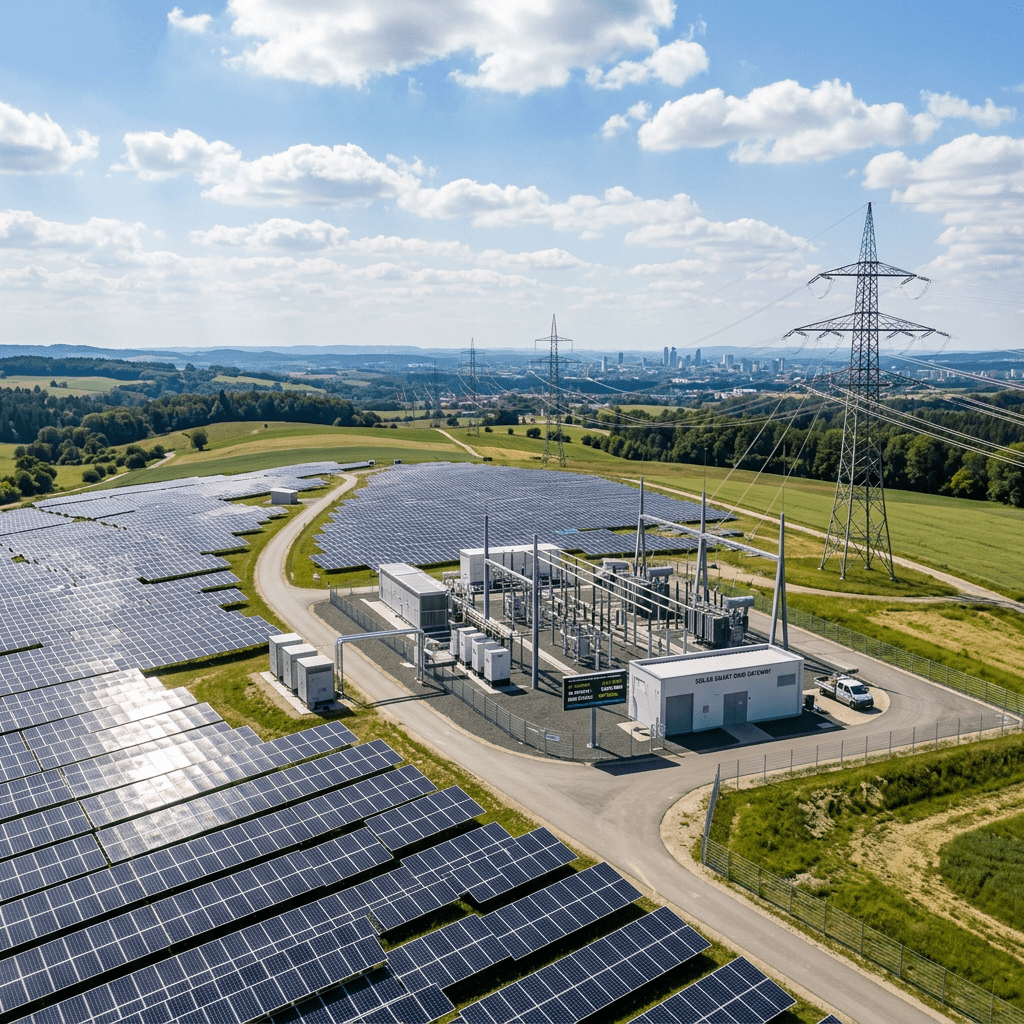
As solar power capacity continues to grow across the world, one of the biggest technical challenges is transmitting electricity from solar plants to demand centers efficiently and reliably.
Why it matters: A 50MW pipeline is worth zero if the local substation has a five-year waiting list; learn to pitch storage as a grid-bypass tool or watch your projects stall.
Stop obsessing over whether your TOPCon modules are hitting 22.5% or 22.8% efficiency. In the current European market, the efficiency of your silicon is irrelevant if your grid connection agreement is stuck in a five-year queue. We have moved from an era of 'resource scarcity' to 'infrastructure scarcity.' If you're a developer in the Netherlands or parts of Germany, you already know the pain: you have the land, the capital, and the permits, but TenneT or Netze BW tells you the local substation is at 'code red' capacity.
The 'Smart Grid' Isn't a Magic Wand
The industry loves to throw around 'Smart Grid' as a catch-all solution, but for a field engineer, that translates to very specific, high-stakes hardware. We are seeing a shift toward Dynamic Line Rating (DLR). Traditionally, transmission capacity is calculated using static, worst-case scenarios—assuming a hot, windless day. DLR uses real-time weather sensors to allow 20% to 30% more current through existing wires when conditions allow. For an IPP, that 30% headroom is the difference between a project being bankable and being a stranded asset.
The Strategy for Survival
If you are pitching a 10MW+ project today without a storage component, you are building a liability. In Spain, we've seen curtailment rates spike because the 'evacuation'—the physical movement of electrons—can't keep up with midday peaks. The smart money is moving toward hybridization. By pairing PV with a 2-hour BESS, you aren't just 'evacuating' power; you're time-shifting it to bypass grid congestion windows. We’ve seen this pattern before in the early 2010s with residential solar; now it’s happening at the transmission level.
The hard truth? The EU Grid Action Plan aims for €584 billion in investment by 2030, but transformers don't grow on trees and skilled high-voltage technicians are rarer than honest politicians. Your competitive advantage in 2025 won't be your procurement price—it will be your ability to secure and optimize a grid tap.