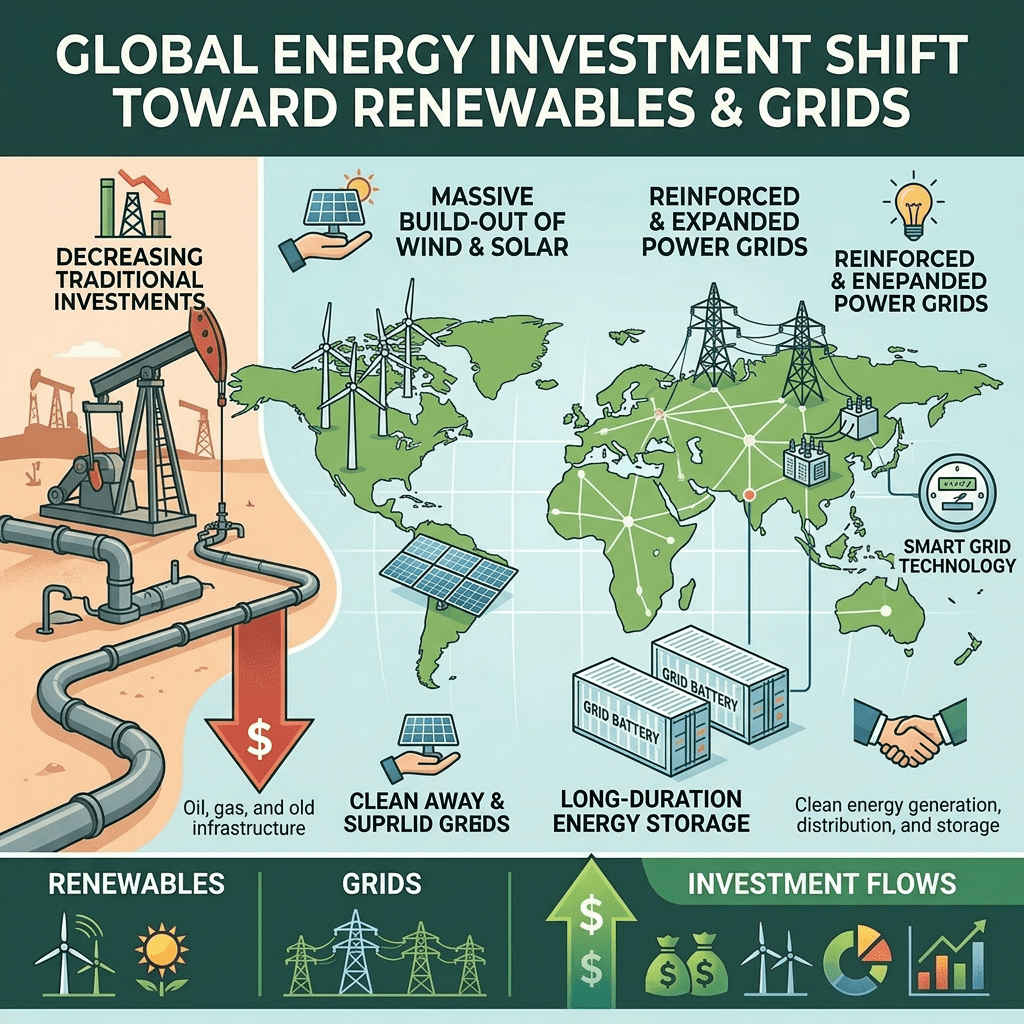
The Middle East conflict and Strait of Hormuz closure have sparked a major global energy security crisis, prompting countries to rethink energy strategies.
Why it matters: Energy security is the new ROI; pivot your C&I pitches from 'saving the planet' to 'saving the business' to close deals in this volatile market.
Remember 2022? When TTF gas prices spiked to €340/MWh and every mid-sized manufacturer in Germany or Italy suddenly realized their "efficient" gas furnace was a liability? We are back in that movie, but the sequel has a much higher budget. The IEA’s projection of $3.4 trillion in energy investment isn't just a big headline number; it represents a massive, panicked capital flight from volatility toward the only asset class that offers predictable costs: renewables.
The Death of the 'Green' Pitch
If you are still selling PV systems based on carbon footprints and ESG goals, you are missing the boat. In the wake of a Strait of Hormuz closure, your C&I (Commercial & Industrial) clients aren't thinking about the planet—they are thinking about continuity. A 500kWp rooftop array paired with 1MWh of high-discharge BESS (think Tesvolt or Ads-tec Energy) is no longer a 'sustainability project.' It is a business insurance policy. When the maritime transport of LNG is throttled, the IRR calculation changes overnight because the alternative isn't 'cheaper grid power'—it's 'no power at all.'
The Coal Complication
The IEA notes that coal investment is rising alongside renewables. For the European installer, this is a double-edged sword. While it keeps the lights on, it also increases grid congestion and carbon pricing pressure. We are going to see DSOs (Distribution System Operators) get even more aggressive with export limitations. The Lesson: If you aren't integrating sophisticated energy management systems like the SMA Data Manager M or Solar-Log into your bids now, you're building systems that will be throttled the moment the grid feels the strain of increased baseload coal and intermittent solar.