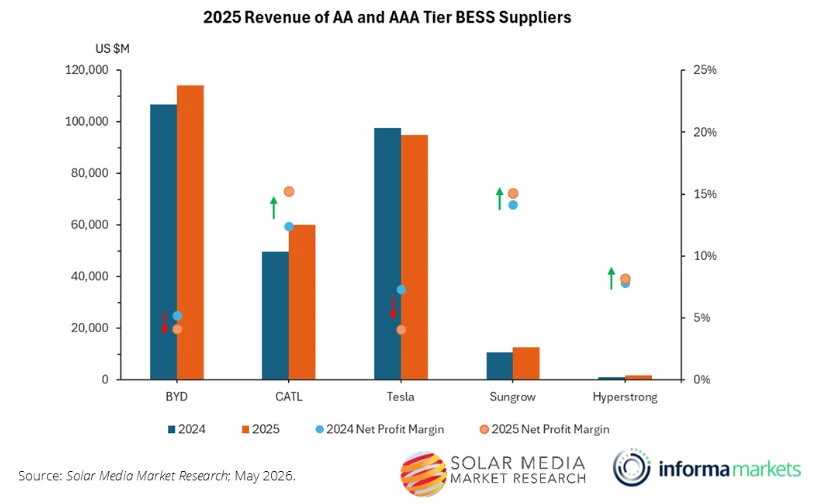
Solar Media Market Research analyst Charlotte Gisbourne looks at the changing revenue and margin dynamics in the BESS supplier landscape.
Why it matters: Stop acting as a logistics firm for glass; if you aren't integrating BESS, you're leaving 40% of your potential project margin on the table.
If you’re still trying to keep the lights on by chasing the spread on 430W N-type modules, you’re playing a losing game. The "glass race" has hit the floor, and in markets like Germany and the Netherlands, module prices have become a rounding error in the total project CAPEX. The real money—the kind that pays for the Porsche in the owner's parking spot—has shifted entirely to the BESS (Battery Energy Storage Systems) stack.
The Hardware Trap
We’ve seen this pattern before. Manufacturers like JinkoSolar and LONGi are locked in a brutal price war that has turned modules into a commodity no different than gravel. Meanwhile, the BESS landscape, dominated by the likes of Sungrow, Tesla, and Huawei, still offers a "system play." You aren't just selling lithium; you're selling frequency response, peak shaving, and the ability to dodge negative pricing—which, let’s be honest, is the only way a 500kW C&I project in the Benelux region makes sense anymore.
The transition from a pure-play installer to an energy solutions integrator is no longer a strategic choice; it’s a survival mechanism. If your 2024 pipeline doesn't include at least 40% of revenue from storage-coupled systems, you are essentially running a high-risk logistics company for Chinese glass manufacturers for free.