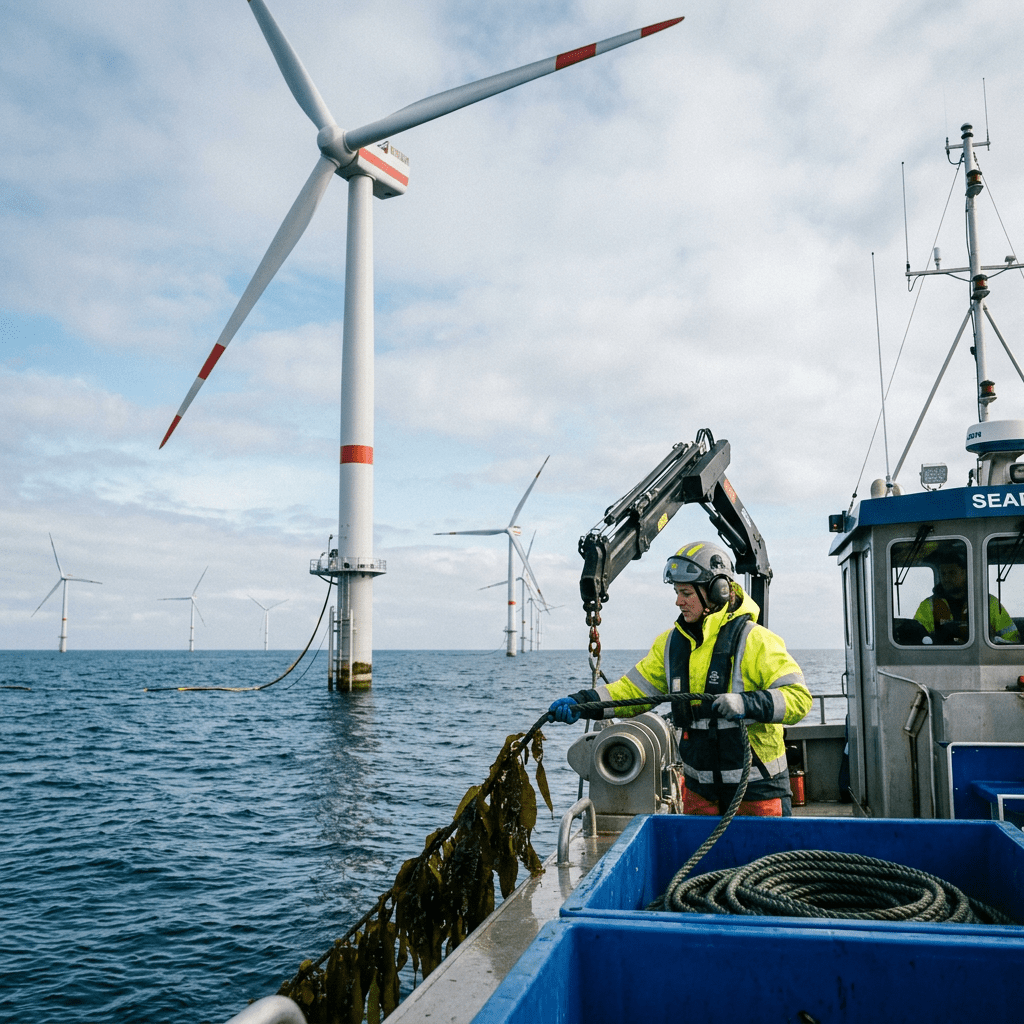
Offshore wind farms are transforming into multi-use platforms, enabling seaweed cultivation alongside renewable energy production.
Why it matters: The 'multi-use' trend is moving from land to sea; if your project doesn't solve two problems at once, you won't win the tender.
The End of Single-Purpose Infrastructure
While the European PV world squabbles over grid connection queues in Brandenburg or Andalusia, the offshore crowd is quietly rewriting the rules of spatial efficiency. This news isn't really about seaweed; it's about the "multi-use" precedent. In the North Sea, where space is a premium commodity, regulators in the Netherlands and Germany are increasingly favoring tender bids that offer more than just electrons. If you aren't thinking about how your next 50MW project serves a secondary purpose, you’re playing a 2015 game in a 2025 market.
The Floating Solar Bridge
The leap from seaweed to Floating PV (FPV) is shorter than you think. Dutch firm Oceans of Energy is already proving that high-wave solar arrays can survive the same brutal environments as these wind farms. For a project developer in the Benelux region or Northern Germany, the signal is clear: the sea is the next frontier for solar to piggyback on wind's existing subsea cable infrastructure. Why spend €200M on a dedicated cable when you can clip onto a 2GW offshore wind hub?
We've seen this pattern before with land-based solar. First, it was just panels; then it was panels + sheep; now it's panels + crops + batteries. The offshore wind sector is simply skipping the first three steps. If you're a developer, start scouting FPV partnerships now, or prepare to be locked out of the largest European energy hubs by 2030.