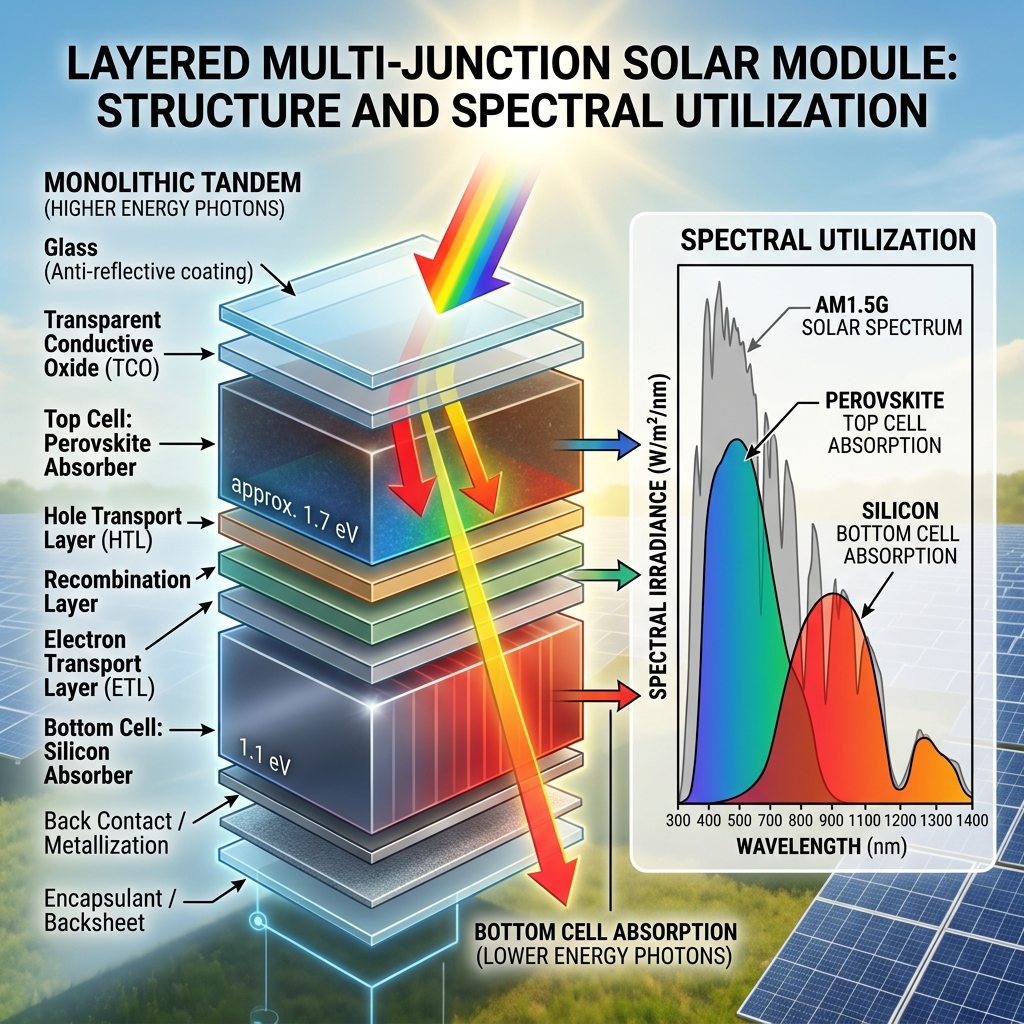
By stacking two materials with different bandgaps, these cells can harness more solar energy efficiently, achieving over 33% efficiency in labs.
Why it matters: Efficiency records sell headlines, but durability sells 25-year PPA contracts; don't pivot your portfolio until the warranties match current silicon standards.
Lab records are the vanity metrics of the solar world. While researchers at places like Oxford PV or Fraunhofer ISE are hitting 33% efficiency, your average installer in the Netherlands or Germany is still wrestling with the practical reality of n-type TOPCon modules. The "tandem revolution" sounds great on paper, but we need to talk about the elephant in the room: chemical stability.
The Durability Gap
Perovskites are notoriously sensitive to moisture and heat. In a lab, you can encapsulate them in a vacuum; in a residential install in rainy Belgium, they face twenty years of thermal cycling and humidity. If a tandem module delivers 30% more power but degrades at 2% per year instead of the 0.4% we expect from high-end silicon, the LCOE (Levelized Cost of Energy) math falls apart. We’ve seen this movie before with early thin-film adopters who got burned when manufacturers folded or products delaminated.
The Labor Arbitrage Play
Where this actually changes the game for European pros is the labor-to-watt ratio. With installation costs in markets like Germany frequently exceeding the cost of the hardware itself, a 500W+ residential module in a standard 1.7m² footprint is a massive win. You’re using the same number of K2 or Van der Valk mounting brackets and the same man-hours to produce 25% more energy. That’s where the margin is. If tandem tech hits the 25-year performance warranty benchmark, it will instantly kill the low-efficiency budget market because the labor savings will outweigh the panel premium.
What to Watch in 2025
Don't get distracted by the efficiency percentages. Instead, watch the IEC 61215 testing results for these tandem modules. Until we see perovskite-silicon stacks passing the same accelerated aging tests as standard mono-perc, they remain a specialized product for space-constrained projects, not a fleet-wide solution. If you're a developer, keep your eye on the PID (Potential Induced Degradation) data—that's where the real story is hidden.