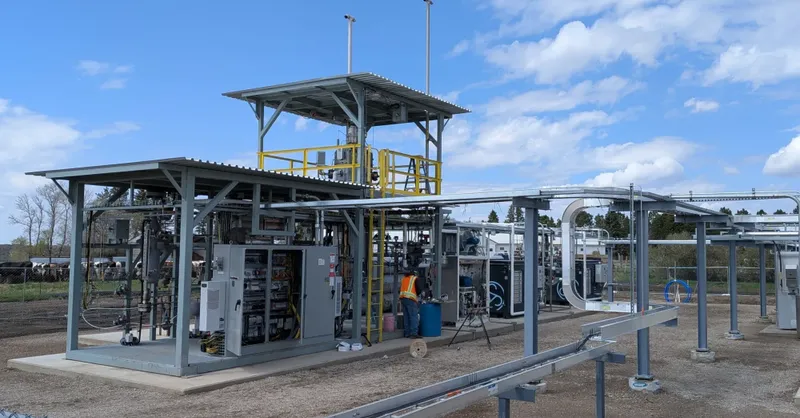
In the shadow of a wind turbine on a low rise just outside the western Minnesota town of Morris, a cluster of tanks, pipes, and sheds holds what some believe is the key to a more self-sufficient future for the region’s agriculture and heavy industry.
Why it matters: If your 10MW project is getting throttled by grid congestion, stop selling electrons and start selling green fertilizer to the local market.
While the headlines focus on Minnesota wind, the smart money in Europe is looking at this as a blueprint for oversized solar off-take. We are currently witnessing a massive disconnect: EU solar capacity is skyrocketing—hitting over 260 GW in 2023—while grid operators in Spain, Poland, and the Netherlands are increasingly slapping developers with curtailment orders. If you are still building projects based on a 20-year PPA with a utility, you are playing a legacy game that’s about to get very expensive.
The Molecule vs. Electron Arbitrage
The Minnesota project isn't just about 'green' vibes; it's about localized industrial autonomy. For a developer in the EU, particularly those eyeing Agri-PV in the 10MW to 50MW range, the path to bankability is shifting from electrons to molecules. Here is why the math works better:
The Harsh Reality for EPCs
We’ve seen this pattern before. Early adopters of BESS made a killing before the margins compressed. Now, the pivot is toward Power-to-X. If your engineering team doesn't understand the integration of a DC-coupled electrolyzer with a Haber-Bosch skid, you aren't a developer; you're just a panel installer. The Minnesota plant proves that the tech is ready for the field. In the EU, where ammonia prices have swung wildly between €400 and €1,000 per ton due to gas volatility, a solar-fed ammonia plant offers a price floor that no utility PPA can match.