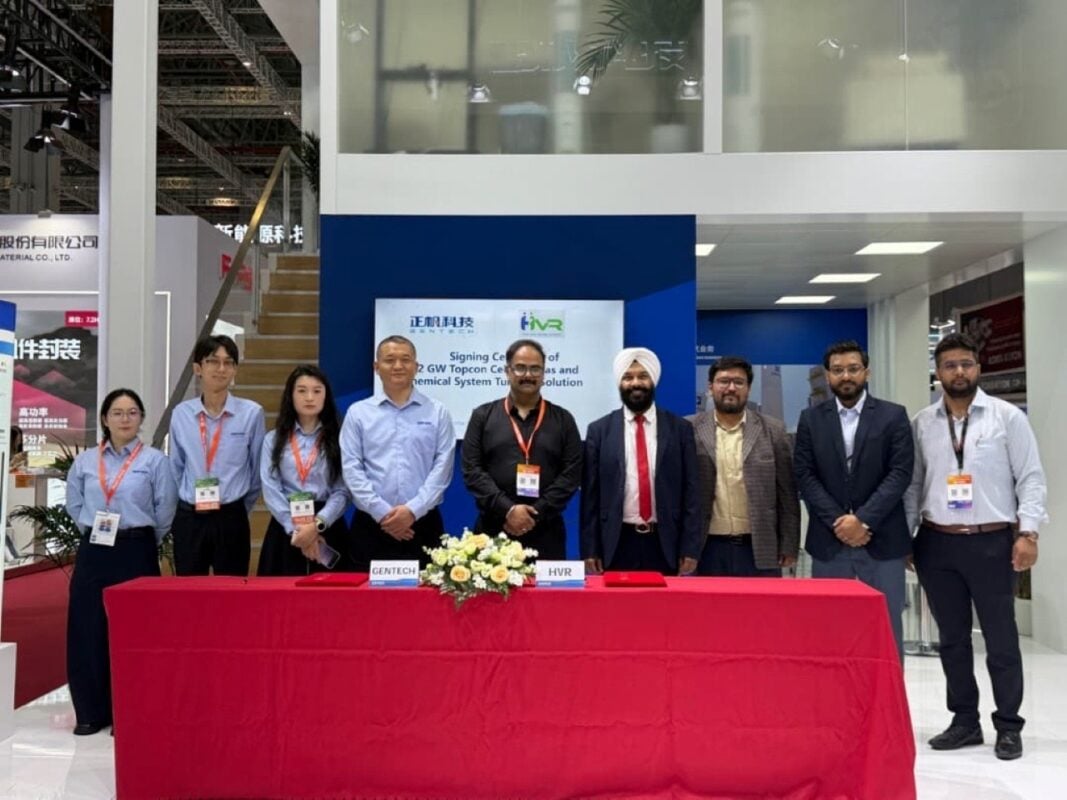
HVR Solar has signed a series of agreements to develop of a 1.2GW TOPCon solar cell manufacturing plant in Amroha, Uttar Pradesh.
Why it matters: India's growing cell capacity is being hoarded by the US and its own domestic market, leaving Europe as the primary dumping ground for Chinese oversupply.
On paper, 1.2GW of TOPCon cell capacity in Uttar Pradesh looks like another brick in the wall of global supply chain diversification. For a European EPC looking to de-risk from the Mainland China monopoly, news of Indian expansion usually triggers a hopeful 'is this our alternative?' But let’s look at the cold, hard logistics before you start asking your wholesalers for Indian-made modules.
The US-India Vacuum
Here is the reality of the global solar trade: India’s domestic manufacturing boom, fueled by the PLI (Production Linked Incentive) scheme and protected by the ALMM (Approved List of Models and Manufacturers), isn't designed to lower prices in the Port of Rotterdam. Currently, any non-Chinese cell capacity that isn't consumed by India’s own massive internal targets is immediately vacuumed up by the US market. Why? Because US buyers are desperate for UFLPA-compliant components and are willing to pay a premium that makes European margins look like pocket change.
The Technology Lag
HVR is betting on TOPCon. While TOPCon is the current 'goldilocks' technology for efficiency and cost-of-capital, a 1.2GW plant is a rounding error compared to the 50GW+ mega-sites we see from Jinko or JA Solar. By the time this facility in Amroha hits nameplate capacity and clears its yield-rate hurdles, the tier-one Chinese players will be deep into HJT (Heterojunction) or Perovskite-Silicon tandems. If you are building a utility-scale project in Spain or Poland, you aren't just looking for 'not Chinese'—you're looking for the lowest LCOE. A 1.2GW factory lacks the economies of scale to compete on price with the M10 or G12 wafer giants unless the EU introduces much more aggressive local content requirements.
Wait for the 'Made in India' Premium
Expect Indian cells to carry a 15-20% price premium over their Chinese equivalents. Unless your client is a corporate entity with a hyper-specific ESG mandate that explicitly forbids Chinese sub-components, the math for a 10MW C&I rooftop simply won't favor this capacity. This news is a win for Indian energy independence, but for the European installer, it’s just another factory whose output you’ll likely never see on your job site.