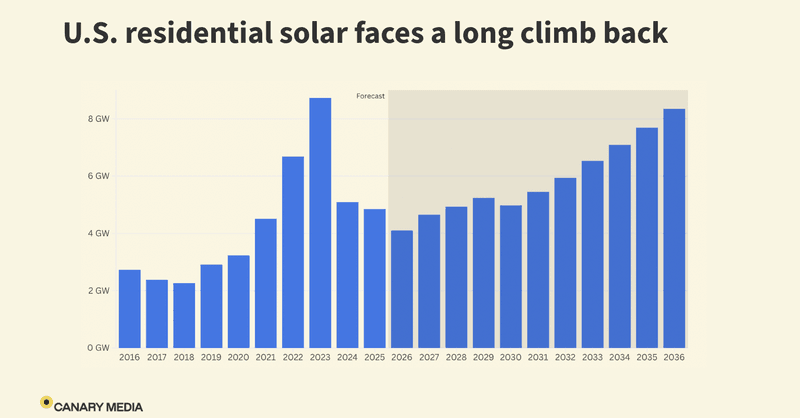
With solar panels getting cheaper each year and utility bills soaring, you might expect rooftop solar to be booming in the U.S. That’s not the case.
Why it matters: The U.S. collapse proves that low hardware prices are irrelevant if your local utility or regulator decides to kill the ROI through grid fees or export cuts.
We’ve been told for a decade that the 'Learning Curve'—the relentless drop in module prices—would make solar an unstoppable juggernaut. But the U.S. market is currently proving that you can have $0.11/W modules and still go bankrupt if your policy environment turns toxic. For an installer in Essen or Lyon, the American slump isn't just 'over there' news; it’s a blueprint for what happens when a market matures and the training wheels come off.
The Policy Cliff is Real
The U.S. isn't failing because people stopped liking the sun. It’s failing because the financial engineering that propped it up—specifically high-ratio Net Energy Metering (NEM)—is being dismantled. California’s NEM 3.0 transition slashed export compensation by roughly 75%, and the result was a bloodbath for installers who didn't know how to sell storage. European professionals should be looking at the Dutch salderingsregeling phase-out with the same level of anxiety. If your sales pitch depends entirely on the grid acting as a free battery, you’re selling a product with an expiration date.
The 'Soft Cost' Trap
In the U.S., customer acquisition costs can exceed $3,000 per household. While EU installers enjoy much lower 'soft costs,' we are seeing a creep in regulatory friction. Whether it’s the VDE-AR-N 4105 requirements in Germany or the shifting VAT exemptions in the UK and Netherlands, the administrative burden is rising just as margins are compressing. Enphase and SolarEdge have already felt the sting of the U.S. slowdown; expect them to push harder—and perhaps more desperately—into the European market to make up the volume. This is the time to squeeze your distributors for better terms, not to expand your overhead.
Stop betting on subsidies. If your business isn't viable at a 5-8% interest rate environment without a government check, you don't have a business; you have a temporary hobby funded by taxpayers.