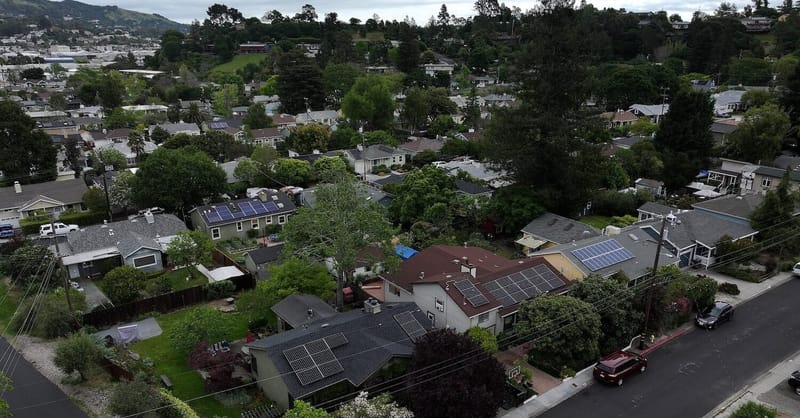
Sunrun, Tesla, and Renew Home announced an agreement to create what could be the country’s biggest virtual power plant — or, more precisely, a lot of VPPs in data center hot spots.
Why it matters: Residential storage is transitioning from a 'backup' luxury to a vital utility-scale asset—if your systems aren't VPP-ready, they're already obsolete.
16 gigawatts. Let that sink in for a moment. That is not a pilot project or a marketing stunt; it’s nearly the entire peak load of a medium-sized European nation. While many installers in Europe are still stuck in the 2021 mindset of selling 'autarky' and 'saving on the bill,' the US giants are pivoting to the only game that actually matters for long-term margins: grid-scale orchestration of residential assets.
The Data Center Arbitrage
The strategic brilliance here is the focus on data center hotspots. As AI-driven demand threatens to break grids from Northern Virginia to Dublin and Frankfurt, the 'peaker plant' of the future isn't a gas turbine—it's ten thousand Powerwalls acting in unison. If you’re an installer in a constrained market like the Netherlands or parts of Southern Germany, you need to stop selling PV as a product and start selling congestion relief. The hardware is becoming a commodity; the software-enabled dispatch is the high-margin service.
For the EU professional, this is the blueprint for navigating regulations like Germany's Section 14a EnWG. We are moving toward a reality where the grid operator will pay you to throttle or discharge. If you aren't building your business around brands that have a seat at the VPP table—think Tesla, sonnen, or those integrated with aggregators like Next Kraftwerke—you are essentially selling your customers a car that can't connect to the highway.
The Money Angle: In a market where module prices have crashed by 50% in a year, you cannot survive on hardware markup alone. This 16GW deal proves that the real ROI for the next decade lies in the 'flexibility' revenue. If your C&I proposals don't include a line item for grid-balancing income, you're leaving 15-20% of the project’s lifetime value on the table for your competitors to scoop up.