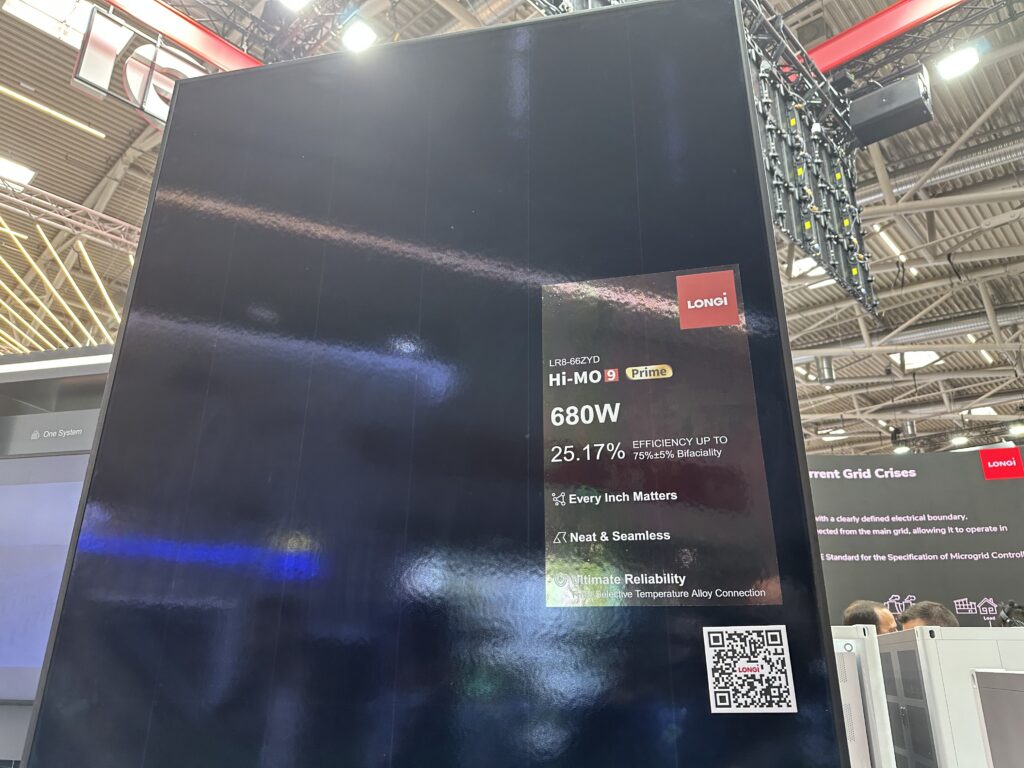
Longi ha presentado el Hi-MO 9 Prime, un nuevo módulo de contacto posterior basado en la tecnología HPBC que ofrece una potencia de salida de hasta 680 W y un rendimiento del 25,2 %.
Why it matters: Efficiency is the only hedge against rising land and labor costs; if you aren't planning for 24%+ modules in your 2025 pipeline, your bids will be underwater.
We are officially entering the 'Efficiency Ceiling' era. For years, we’ve watched manufacturers crawl from 19% to 22% with incremental PERC and TOPCon tweaks. But LONGi hitting 25.2% with the Hi-MO 9 Prime isn’t just another press release; it’s a shot across the bow of every Tier-2 manufacturer still trying to master basic n-type cells. By leveraging their Hybrid Passivated Back Contact (HPBC) architecture and eliminating cell gaps, LONGi is moving the goalposts for the entire European utility and C&I market.
The LCOE Math for Land-Constrained Europe
In markets like the Netherlands or Germany, where land lease costs and permitting hurdles are the primary project killers, every square centimeter of silicon must work harder. A 680Wp module at 25.2% efficiency means you’re squeezing significantly more energy out of the same fixed costs—racking, cabling, and labor. We’re looking at a potential 3-5% reduction in Balance of System (BOS) costs compared to standard 22% efficient modules. If you're bidding into a Spanish PPA at €35/MWh, that efficiency gap is the difference between a bankable project and a vanity exercise.
The Aesthetic Trojan Horse
Don't be fooled by the 'Prime' branding—this tech will migrate. While the 680W beast is aimed at large-scale arrays, the underlying HPBC tech is the real story for C&I installers. The 'hidden busbar' design isn't just about reducing shading losses; it creates a sleek, uniform aesthetic that high-end commercial clients in Milan or Paris are actually willing to pay a premium for. LONGi is essentially positioning itself to eat Maxeon’s lunch in the premium segment while maintaining the scale to crush Aiko on price.