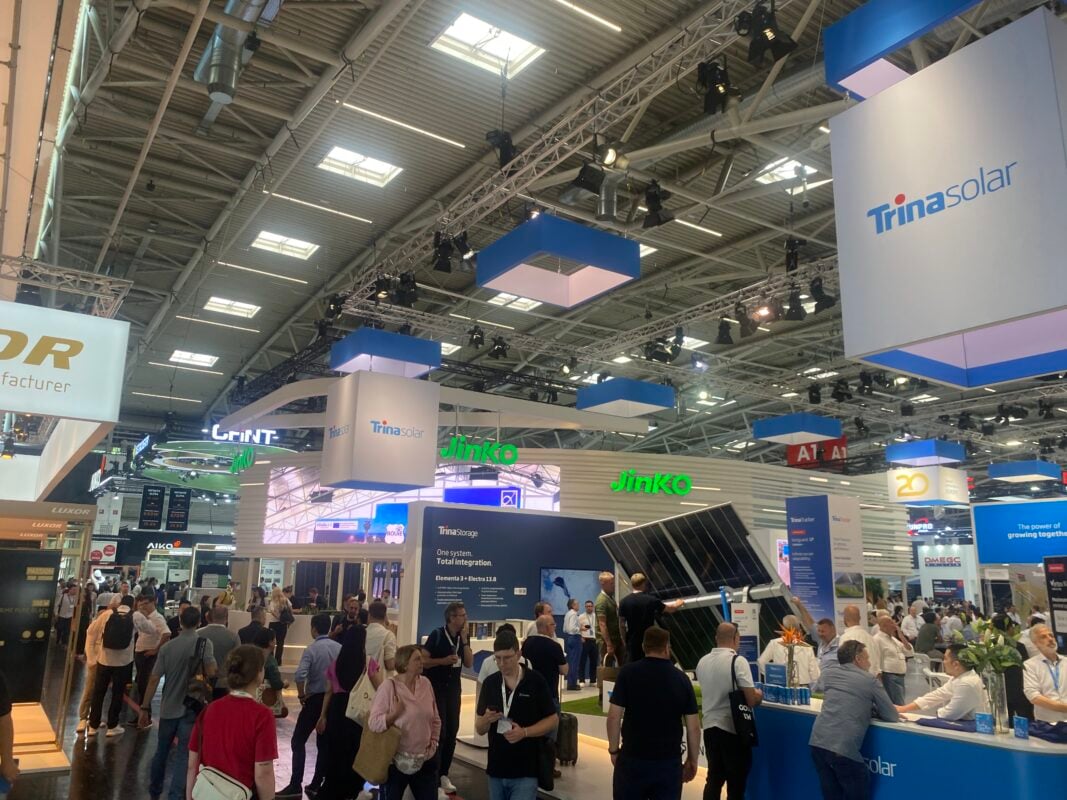
Europe’s solar industry seemed a little downbeat as it trudged to Munich for Intersolar Europe 2026 this week.
Why it matters: The era of high-margin 'panel pushing' is dead; your survival now depends on mastering complex storage integration and dynamic energy management.
Walking the halls of Messe München this year felt less like a tech expo and more like a support group for EPCs who over-leveraged during the post-2022 gold rush. The "downbeat" energy isn't just heat exhaustion; it's the realization that the era of 'order-taking' is officially over. If you were looking for the 30% margins of yesteryear, you’re in the wrong decade. We’re seeing module prices hovering at a soul-crushing €0.09-€0.11/Wp for Tier 1 TOPCon, and while that’s a win for project IRRs, it’s a bloodbath for the distributors still sitting on 2025 stock.
The Death of the 'Panel Pusher'
The spectral presence at every booth wasn't a new high-efficiency cell; it was the policy shift. With the Dutch salderingsregeling (net metering) finally being phased out and Germany’s grid constraints reaching a breaking point, the industry is waking up to a harsh reality: Sticking panels on a roof is no longer a business model—it’s a commodity service.
The installers who looked miserable in Munich are those who failed to pivot. If your 2026 strategy still relies on simple PV-only residential installs, you are essentially a high-end roofer. I spoke with three mid-sized German installers who are facing a 20% headcount reduction because they couldn't transition to complex C&I storage fast enough. The market is bifurcating into 'low-margin laborers' and 'energy system integrators.'
Where the Money Is Hiding
The gloom in Munich is just the sound of the 'easy money' leaving the room. It’s a necessary correction. The professionals who stay will be the ones who stopped selling hardware and started selling hedge-against-volatility solutions.