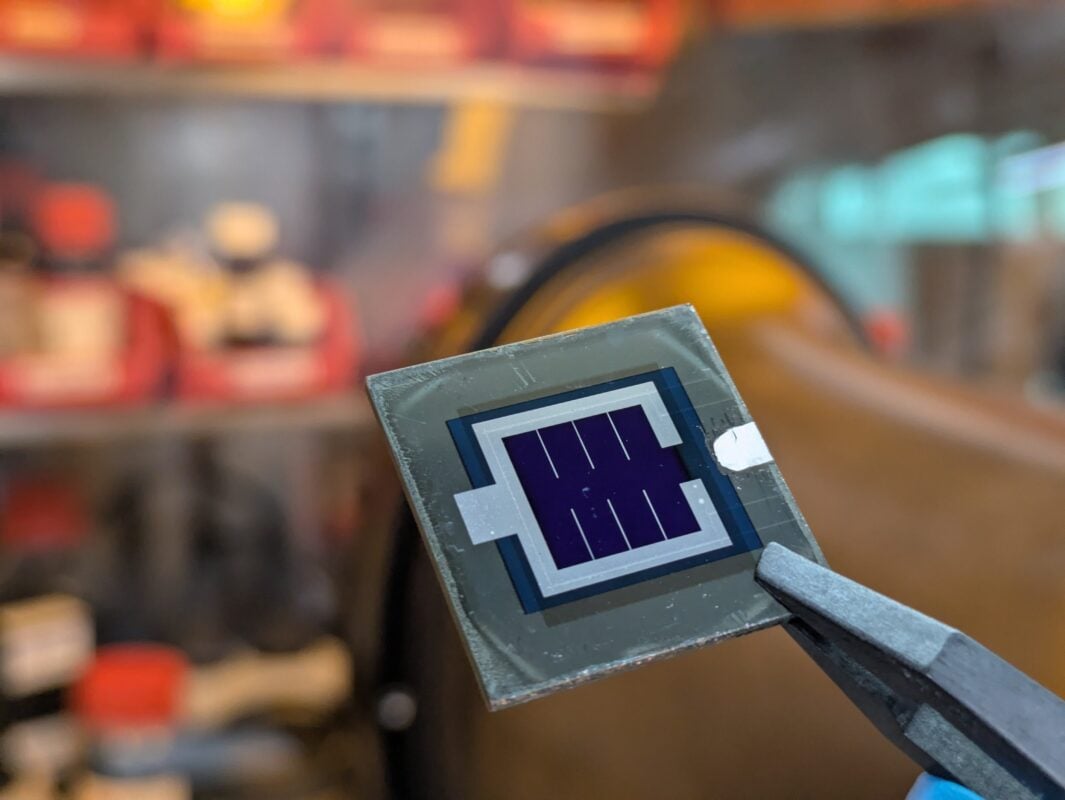
Researchers from HZB and Humboldt-Universität in Berlin have achieved a record 25.5% conversion efficiency in a CIGS-perovskite tandem PV cell.
Why it matters: Lab records don't build projects; until this survives 25 years on a rainy roof in Essen, keep your procurement focused on high-efficiency TOPCon and HJT.
I’ve walked the floors at Intersolar for fifteen years, and every year there is a 'breakthrough' in thin-film that promises to end the hegemony of crystalline silicon. This 25.5% result from HZB and Humboldt-Universität is scientifically impressive—breaking the quarter-efficiency barrier with a non-silicon bottom cell is no small feat—but for the person actually signing off on a 5MW PPA in Brandenburg, it’s a distraction.
The Ghost of CIGS Past
We’ve seen this movie before. Remember Solibro? Remember Hanergy? The industry is littered with the corpses of companies that tried to scale CIGS (Copper Indium Gallium Selenide). While CIGS offers flexibility and a lower carbon footprint, it has consistently lost the cost-per-watt war against the sheer industrial scale of Chinese mono-PERC and now TOPCon. By adding a perovskite layer to achieve 25.5%, researchers are chasing efficiency, but they are doubling down on complexity. In the field, complexity equals risk.
The Reliability Gap
The real issue isn't the 25.5% headline; it’s the T90 lifetime. Silicon is boring because it works for 30 years. Perovskites are notorious for degrading when they see a drop of moisture or a spike in UV. If you’re an installer, imagine the O&M nightmare of a tandem module where the top layer degrades 10% faster than the bottom. Your string inverter’s MPPT will be fighting a losing battle against mismatched internal currents. Unless Avancis or another EU thin-film player can prove these cells survive a damp-heat test for 2,000 hours, this is a paper tiger.
The BIPV Niche
Where this actually matters is the specialized BIPV (Building Integrated PV) market. If you are cladding a curved facade in Paris where weight is a constraint, a high-efficiency thin-film tandem is a game-changer. But for the 95% of us building utility-scale or residential rooftops, the math remains simple: Oxford PV is already pushing silicon-perovskite tandems toward 28% and higher. If you're going to bet on the 'tandem revolution,' bet on the one that uses the silicon supply chain we already have, not a CIGS base that is effectively on life support.