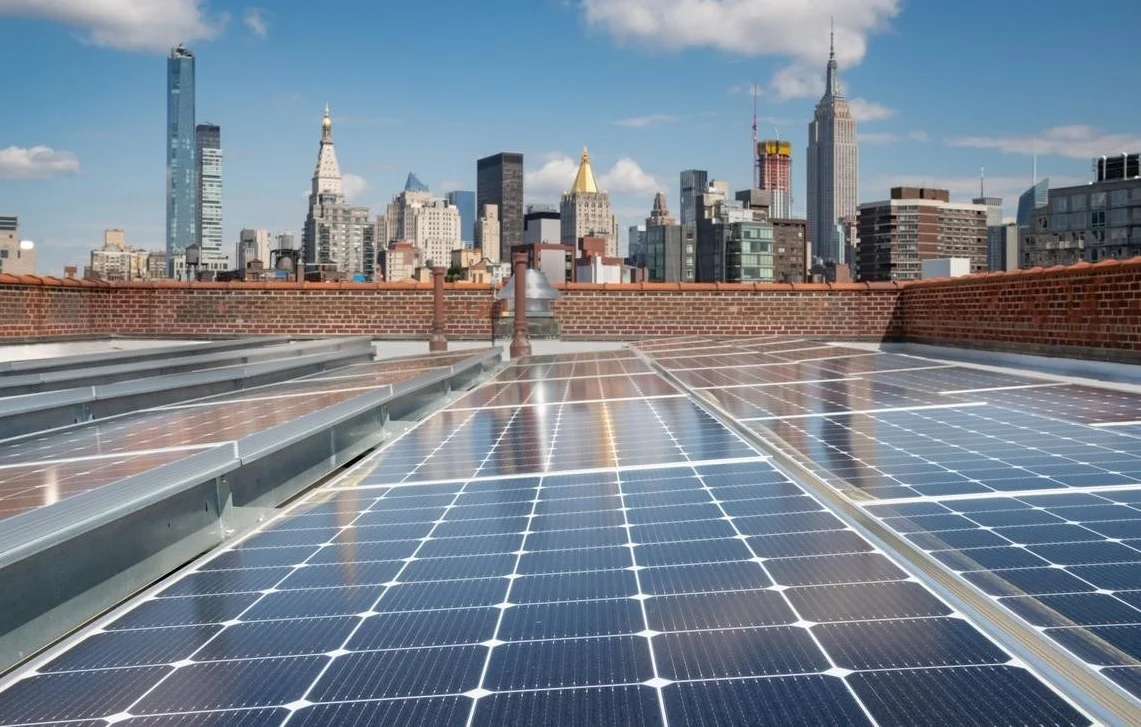
The state of New York has reached 8GW of cumulative installed distributed solar PV, putting the state ahead of its 10GW target by 2030.
Why it matters: New York's success proves that distributed community solar is the fastest way to bypass grid congestion and hit targets early.
While European developers are busy crying into their beer over five-year grid connection queues in Brandenburg or the North of England, New York just gave us a masterclass in how to actually move the needle. Reaching 8GW of distributed solar—ahead of schedule—isn't just a win for the Empire State; it’s a direct challenge to the utility-scale obsession that is currently choking the European energy transition.
The VDER Secret Sauce
The reason New York is winning while we’re stalling is their Value of Distributed Energy Resources (VDER) mechanism. Unlike the blunt instruments of old-school Feed-in Tariffs or the administrative nightmare of many EU net-metering schemes, VDER breaks down the value of a kilowatt-hour based on where and when it’s fed into the grid. It rewards projects that relieve local congestion. For a developer in the Netherlands or Poland facing a 'code red' on grid capacity, the NY model is the only logical exit strategy. You stop building massive solar farms that the grid can't handle and start building smarter, distributed assets under 5MW that the grid actually wants.
Community Solar is the Real Engine
Let’s be honest: 80% of this growth is driven by community solar. In Europe, we’ve spent years talking about Energy Communities under the RED II directive, but the implementation has been patchy at best. New York simplified the billing. They made it so a tenant in a Brooklyn apartment can subscribe to a project in Buffalo without a PhD in regulatory law. For European installers, the signal is clear: if you aren't pivoting toward multi-tenant C&I and local energy sharing models, you're going to be left fighting for the scraps of a saturated residential market or a locked-out utility sector.
The Margin Play: NY shows that distributed solar isn't just 'small-scale.' It's a massive, cumulative asset class. When you move from 100kW rooftop jobs to 5MW community clusters, your hardware procurement—think Trina Solar modules or Sungrow string inverters—hits a sweet spot of volume pricing without the crushing EPC risks of a 100MW utility site. New York is proof that the periphery is where the profit is.